[Article] Stewardship Salons: Sharing biocultural approaches to foster many ways of knowing and caring for land
CECE Research Assistant Professor, Natalia C. Piland, is one of seven co-authors of the recently published paper, “Stewardship Salons: Sharing biocultural approaches to foster many ways of knowing and caring for land,” in Earth Stewardship. The paper was led by USDA Northern Research Station Social Science Researcher Lindsay K. Campbell, and included a team of practitioners and researchers from the NY State Department of Environmental Conservation, Yale School of the Environment, and the City of New York Department of Parks and Recreation. This collaboration is part of a wider community of practice around stewardship science, where we focus on not only knowledge, but also relationships and solidarity, as enabling conditions towards transformative change.
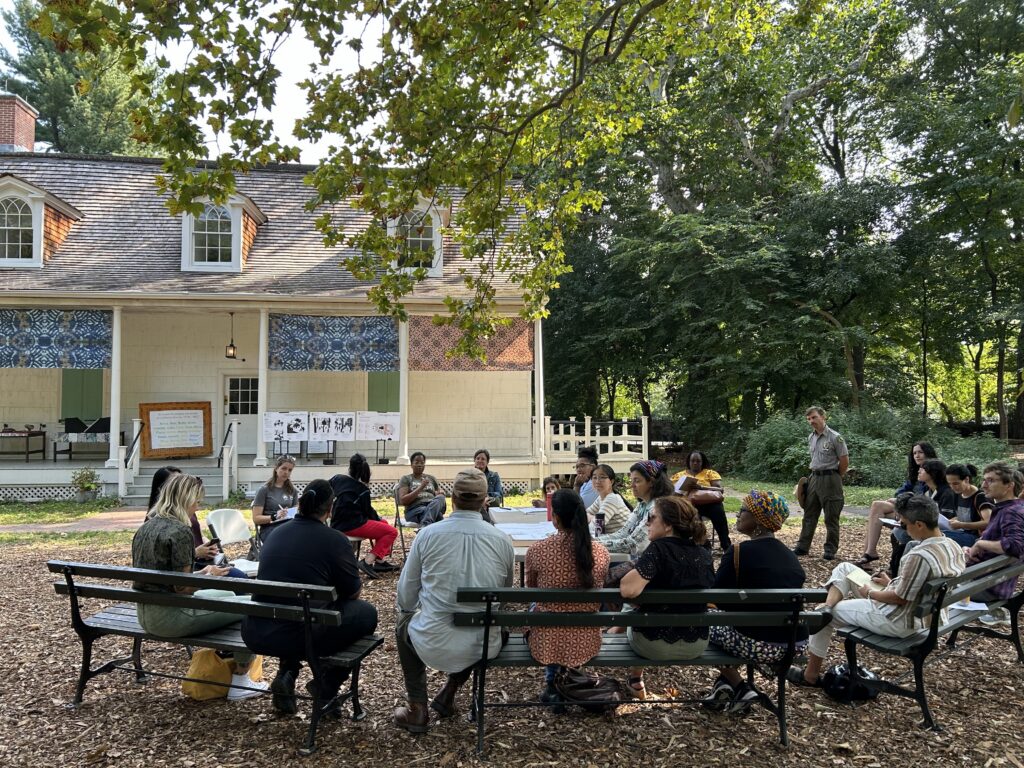
This paper presents Stewardship Salons, a series of convenings that bring together people who care for the environment across the NYC region and across different sectors. In the process, they strengthen their personal and professional development, their relationships to people and place, and their capacity for care. Read the abstract below and click here to read the article:
We present Stewardship Salons as meaningful engagements with different ways of knowing and caring for ecosystems. They are facilitated as non-hierarchical gatherings where everyone has the ability to be a teacher and a learner. This approach was first inspired by an exchange between NYC-based practitioners and Native Hawaiian educators and practitioners in 2017. Since then, partners from USDA Forest Service and NYC Parks have organized experiential salons that engage land managers, artists, researchers, and practitioners in learning from place and each other. Salons are rooted in co-learning, engaging personal lived experiences, and amplifying frequently untold narratives about ecosystems. They have been led by Indigenous Traditional Ecological Knowledge holders, performance and visual artists, community activists and stewards, and different cultural and religious groups who share artistic and embodied ways of knowing and biocultural stewardship practices as pathways towards more holistic approaches to the land rooted in reciprocity and care. This technical article presents our Stewardship Salon approach and draws upon qualitative, mixed-method participant observation and program evaluation data (2017-2024). We identified three primary salon impacts on individuals: personal and professional development, relationship building to people and to place, and bolstering capacity. We discuss outcomes of salons beyond direct participants as well as barriers to participation and limitations of the current approach. We conclude with exploring how salons have the potential to scale from individual impacts to foster organizational change, bolstering care-based approaches to stewardship in urban areas and beyond.