[Article] Drawing Systems of Stewardship to Guide Action and Reveal Critical Relationships of Care
CECE Postdoctoral Fellow Natalia C. Piland is lead author of a new paper in Earth Stewardship titled, “Drawing systems of stewardship to guide action and reveal critical relationships of care.” This paper is a presentation of a tool she, with her co-authors, developed while working at the U.S. Forest Service. The tool is meant to lower activation barriers for discussing who cares for place and community between people who are beginning to build relationships. Read the abstract below and click here to read the article.
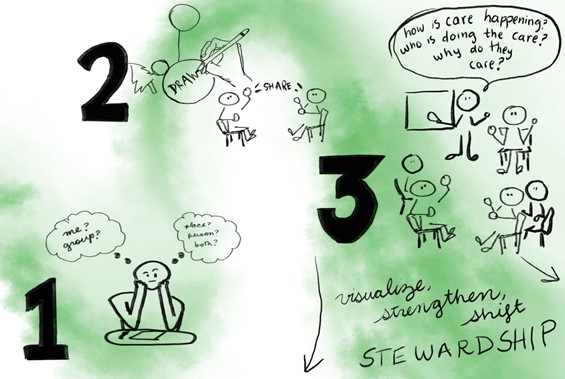
Environmental action, including that which addresses climate change and takes care of the environment more broadly, could be strengthened by making collaboration across silos more imaginable. In this technical article, we describe a ‘“systems of care” tool that facilitates a broad range of participants to express the local and everyday relations that underpin care for their places and communities. Researchers and practitioners who aim to bring together participants from different sectors can implement the tool, using drawings and narrations of these systems of stewardship and care, to find connections and disconnections between participants. Reflexive questions can be tailored to fit the participants, but aim to identify important relations in the system and actions to strengthen them. We show the use of the tool in two case studies: one as part of a community workshop on climate adaptation in New York City, and another in a digital workshop with artists and urban greening practitioners across the world as part of The Nature of Cities Virtual Festival. Through this tool, we can see, in real time, how hyper-local actions and relations can thread into wider networks of environmental stewardship and community care. In particular, the tool unveils aspects of environmental stewardship often uncaptured by other research methods, such as the non-environmental organizations and relations that sustain caretakers. It also allows participants from different contexts to dialogue, finding both common and different elements across their practice and strengthening relationships between them. Finally, it can expand the conceptual and geographic lens at which stewardship is understood by bringing attention to how relations across thematic silos and large physical distances can support local environmental actions. By starting with the relations, actions, and places that already exist, the tool promotes a relational understanding of people-place-organization connections and disconnections that can strengthen the overall system of care while working to repair relationships in environmental governance.
Read the full paper here: https://doi.org/10.1002/eas2.70040