Systems Lens to Increase Sustainable Procurement Success: Co-creating Insights to Bolster Employee Engagement
Sustainable procurement represents one of the most powerful, yet underutilized, levers for advancing environmental and social impact within organizations. Procurement decisions account for most of an organization’s climate emissions and shape labor and equity outcomes across global supply chains. While American University (AU) has earned national recognition for carbon neutrality and strong sustainability performance, its procurement systems have not evolved at the same pace. This project set out to answer a practical and pressing question: how can organizations strengthen employee engagement to improve sustainable procurement outcomes?
Drawing on a systems perspective, the project team partnered with AU’s Offices of Sustainability and Procurement and Contracts to examine procurement not as a series of isolated purchasing decisions, but as an interconnected system of actors, incentives, norms, and feedback. By transforming procurement from a transactional function into a strategic sustainability driver and activating the people who make daily purchasing decisions, institutions like AU can better align operations with institutional values and extend their climate and equity impact far beyond campus.
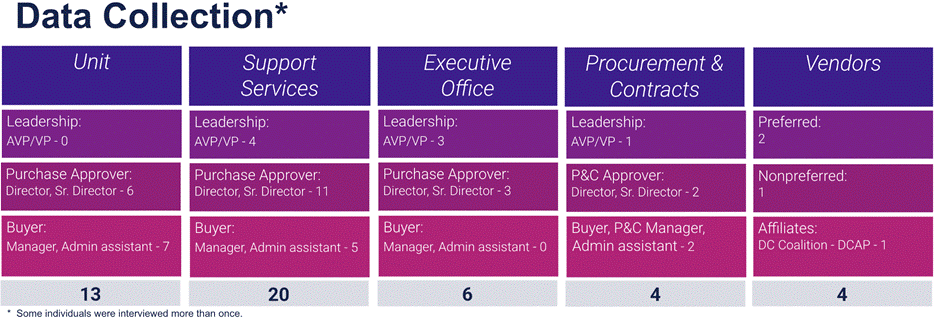
Between spring and fall 2025, the team conducted ~50 semi-structured interviews with procurement officers, departmental buyers, unit leaders, sustainability staff, vendors, and other stakeholders. These interviews examined decision-making structures, barriers to integrating sustainability, information needs, vendor relationships, and improvement opportunities. Interview data were complemented with an analysis of AU’s procurement policies, sustainability reports, benchmarking data from peer institutions, and industry frameworks, allowing researchers to situate stakeholder experiences within broader institutional and sectoral contexts.
Insights from this analysis were translated into systems maps that depicted AU’s procurement landscape, including key decision points, feedback loops, and structural constraints. In two facilitated workshops with 21 stakeholders, participants validated and refined these maps, surfaced additional interconnections, and co-generated solutions. This participatory process ensured that recommendations addressed root causes rather than symptoms and reflected operational realities across the university’s decentralized purchasing environment.
The research identified three interconnected phases of AU’s procurement process: needs assessment and vendor selection; approvals and stakeholder input; and product use and disposal. In each, currently, sustainability plays a limited and inconsistent role. Across interviews and workshops, stakeholders identified a set of reinforcing barriers. Buyers lack accessible, trustworthy information about sustainable products, certifications, and vendors, and they struggle to distinguish legitimate sustainability claims from greenwashing. Time pressures and decentralized purchasing structures lead to reliance on familiar vendors and lowest-cost options, limiting coordination and shared learning. Budget systems emphasize upfront cost rather than lifecycle value, reinforcing the perception that sustainable options are too expensive. Moreover, sustainability remains weakly embedded across procurement policies, training, metrics, and incentives.
Despite these challenges, our research findings, co-produced in collaboration with our stakeholders, generated a robust portfolio of strategies to strengthen sustainable procurement performance. Priorities included creating centralized sustainable vendor databases and product catalogs; implementing systematic training programs; embedding sustainability criteria into RFPs, contracts, and approval workflows; strengthening sustainability-oriented vendor partnerships; selectively centralizing procurement functions to enhance coordination; expanding reuse and circular economy initiatives; and developing metrics to track and reward progress.
The project demonstrates that advancing sustainable procurement requires thinking systemically rather individually. It requires aligning incentives, reducing informational and structural barriers, and embedding sustainability into everyday decision-making. The project positions AU, and organizations more broadly, to treat procurement not as an administrative necessity, but as a strategic engine for climate action and social equity.
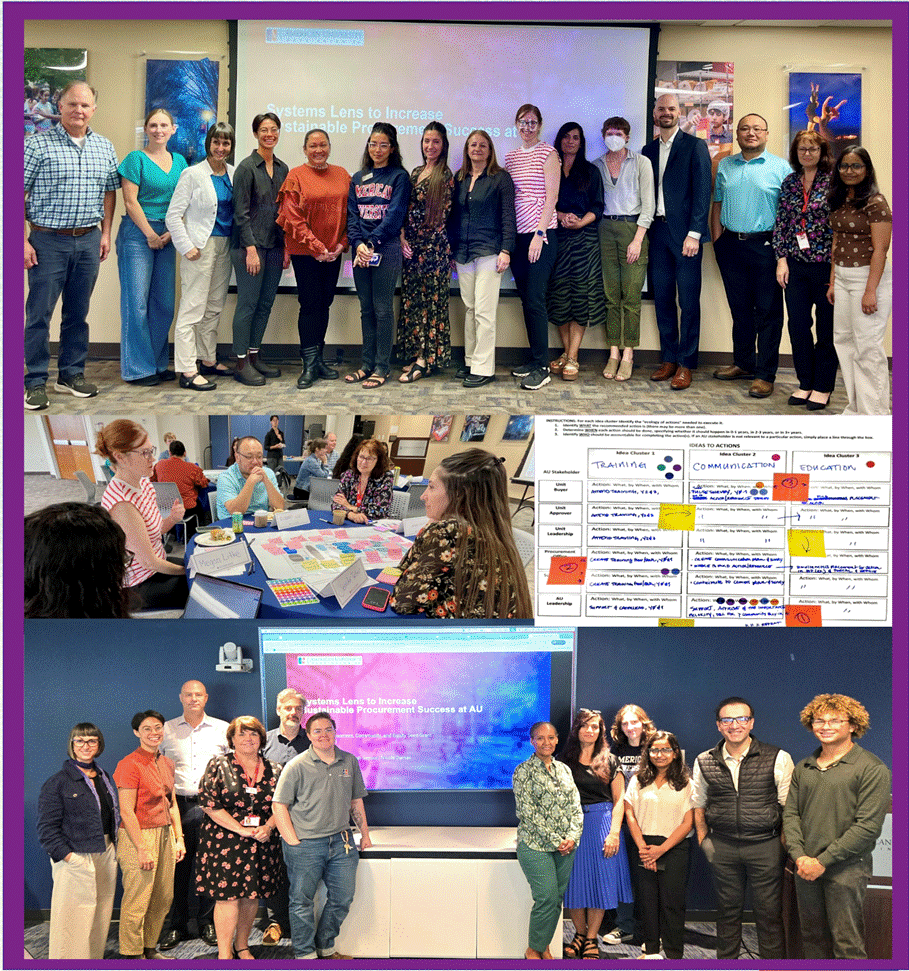
Photos from the Workshops
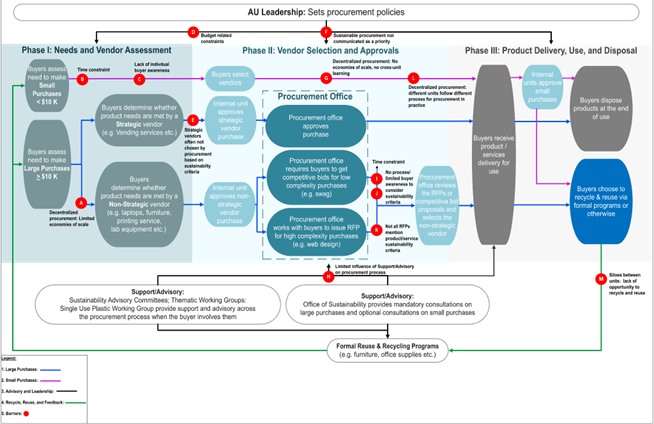
AU’s Procurement System and Barriers to Sustainability