
[Report] Mapping the Election Protection Network in the US
As the 2026 midterm elections draw closer, numerous groups have been preparing to defend the integrity of democracy. Concern about federal interference in the voting process, election certification, and meddling in the results has inspired many groups to deploy strategies to protect the democratic process. During this election cycle, many organizations have gotten involved in election protection. This project aims to understand which organizations are coordinating or collaborating as part of these efforts. I focused on several popular efforts involved in election protection and mapped out the network of organizations connecting them. The findings can help us understand which organizations are involved and what roles they might play if there is a need for rapid response to election interference. These data also help us identify which organizations have invested in training a base of members or volunteers to be ready to respond and/or mobilize the masses.
To understand the ecosystem of organizations leading this work to defend democracy, this analysis focuses on three popular efforts working to support and protect elections leading up to the midterms: Hands Off Our Vote (HOOV), the Election Safeguards Response Network (ESRN), and No Kings. HOOV and No Kings are defined as campaigns because they exist to deploy tactics to accomplish clear, short-term objectives. Although No Kings was originally created to coordinate a day-of-action, it has grown into a broader campaign that has included four national days-of-action, along with various other initiatives designed to protect democracy and protest authoritarianism in the US. ESRN is defined as a coalition because the group describes itself as “a non-partisan convening and collaboration space…planning for, and responding to those trying to undermine our elections” rather than a shorter-term, time-bound campaign. All three of these initiatives have the common goal of preventing federal interference in the midterm elections and all involve multiple organizational partners that employ a range of tactics and programming.
This analysis aims to understand which organizations are involved, how the coalitions and campaigns are connected, and map out who is running trainings with various goals around election oversight, “know your rights” information, rapid response, and/or for a mass mobilization after the election. “Days of action,” planned distributed mobilizations on a specific date connected to HOOV and others, were also identified and included. Coordination between two entities is operationalized by a publicly stated relationship between groups (e.g. Indivisible -> No Kings). ‘Funneling people/volunteers’ is operationalized by a group cross-posting another’s event or call to action on their website or social media (e.g. HOOV linking an ACLU training on their events page).
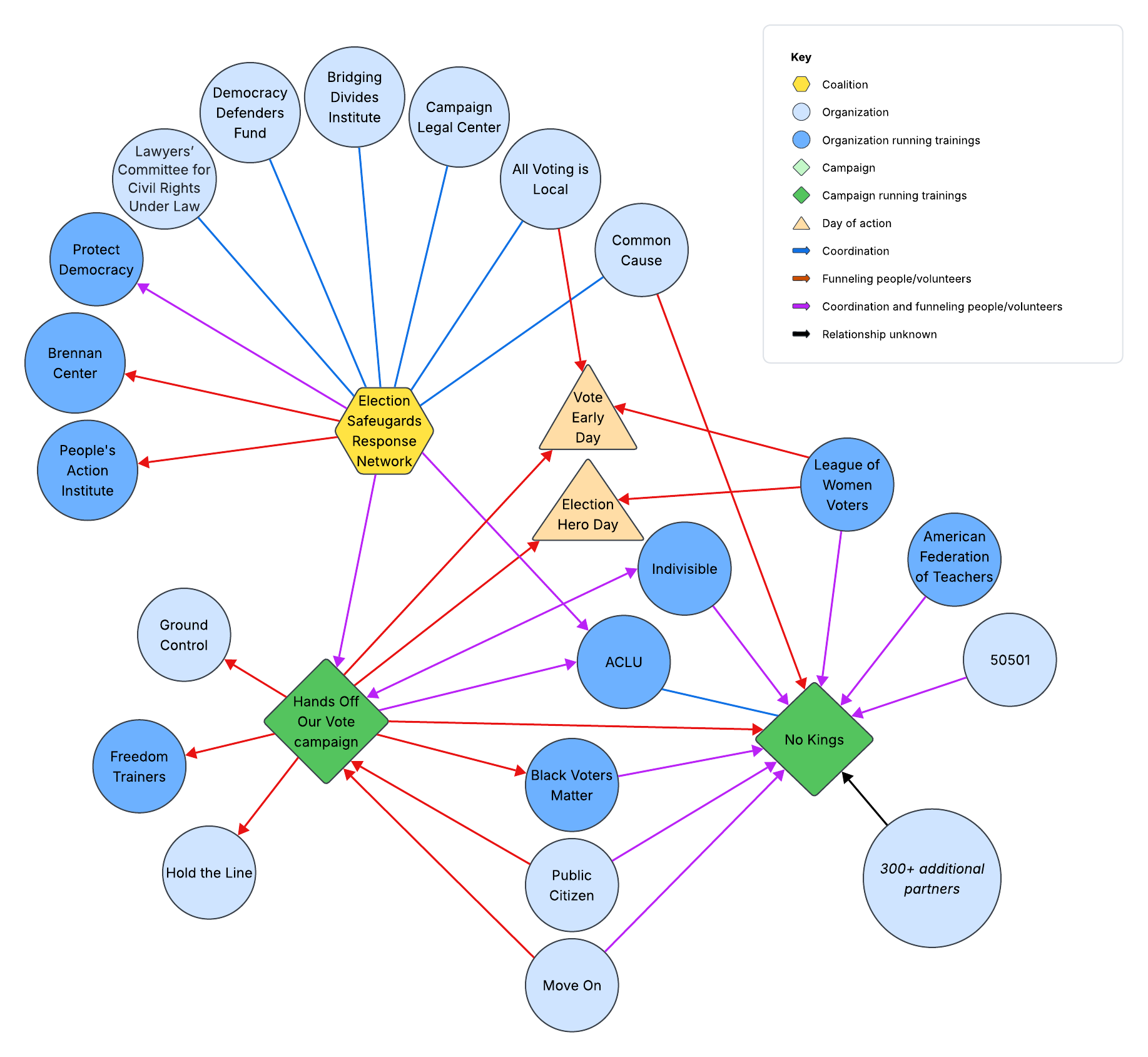
For each effort, data were collected through web searches, along with extensive review of organizational websites, event lists, and social media accounts to collect the necessary information to map the organizations involved in this network to protect democracy. For HOOV, a list of organizations that are hosting trainings or events was collected from the HOOV calendar, including organizations linked as sites for volunteers to get involved. According to a formal presentation and a report on the Connector Substack, three organizations were helping to coordinate the HOOV campaign. The list of ESRN connections was derived from their partner list on their website, as well as from organizations involved in trainings that are listed on their trainings hub. The list of organizations connected to No Kings comes from the steering committee list, along with select partners on the No Kings website. Due to volume, I was unable to identify the specifics of the relationships for the 300+ “partners” on No Kings’ website and for readability I have included one node reflecting them all. However, I do list Common Cause separately because it is the only No Kings partner with a documented connection to one of the other efforts in the analysis: ESRN. After the initial list of connections was plotted, I also checked all organizations for additional public connections to other groups on the diagram. It is important to note that the figue only maps public connections; I was unable to map private connections among these organizations.
The network was visualized using Lucid Chart. Components of the network are listed using the following criteria: Independent organizations are indicated with a blue circle, coalitions are listed as a yellow hexagon, campaigns are depicted as a green diamond, and days of action an orange triangle. Organizations with a darker hue are running trainings. Types of connections are indicated with different colored lines and arrows: for ties where the coordination is documented, the line is blue; if one organization or coalition is funneling volunteers to another group’s action or training (e.g. HOOV -> Ground Control), the line is red; if groups are doing both coordination and funneling people, the line is purple. Arrowheads on red and purple lines indicate the direction people or volunteers are being funneled.
As can be seen in the diagram, although many organizations are funneling people to one another’s actions or events, the organizations with the most coordination with other groups, coalitions, and campaigns are ACLU and Indivisible. These organizations, as well as several others connected to the three central nodes, have been running trainings to build a base of supporters ready to engage in future activities during or after the elections. The diagram also shows that between the several leading organizations and the campaigns and coalitions that have convened multiple partners, relationships of some kind exist between many groups involved in election protection and the network may be well positioned for effective coordination in the event of election interference in this year’s midterm elections.
